A website is only truly built for AI search when its structure, content, technical SEO, trust signals, and page performance make it easy for AI systems to understand, trust, and reference it. No tool – no matter what it promises in its sales page – can guarantee instant rankings inside AI search.
I get the same message almost every week, in some version or another: “Can we get into AI search fast, even though we’re not really ranking on Google?” Sometimes it comes with a screenshot of a cold email promising AI visibility “in 45 days.” Sometimes it’s a founder who watched a YouTube video about ChatGPT recommendations and now wants their brand to “show up in AI” by next quarter.
Here’s the honest answer I give every time: AI search isn’t a side door around a weak website. It’s built on top of the same foundation that’s always mattered – whether your pages can be understood, trusted, and easily cited, not whether you bought the right tool. Tracking across millions of queries shows AI Overviews now trigger on roughly 48% of searches, a sharp jump from a year earlier – which means the businesses showing up there aren’t doing anything magical. They’ve just built websites that AI search engines can actually cite, and that takes real structural work, not a 45-day shortcut.
This article is the version of that conversation I wish I could have with every business owner before they sign up for an “AI ranking” package. It’s a practical readiness check, not a scare tactic and not a pitch.
What AI Search Actually Needs
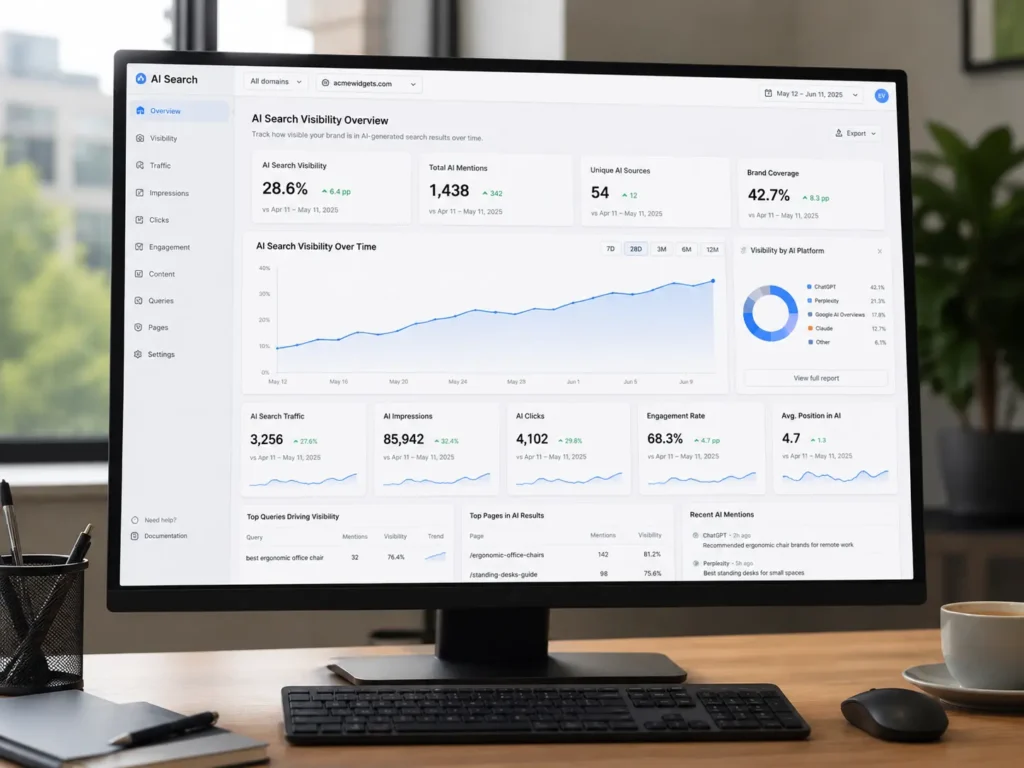
Let’s strip away the buzzwords for a second. AI search – whether it’s Google’s AI Overviews, AI Mode, ChatGPT, or Perplexity – works by pulling from pages it can confidently extract information from. That confidence is built on a handful of unglamorous things.
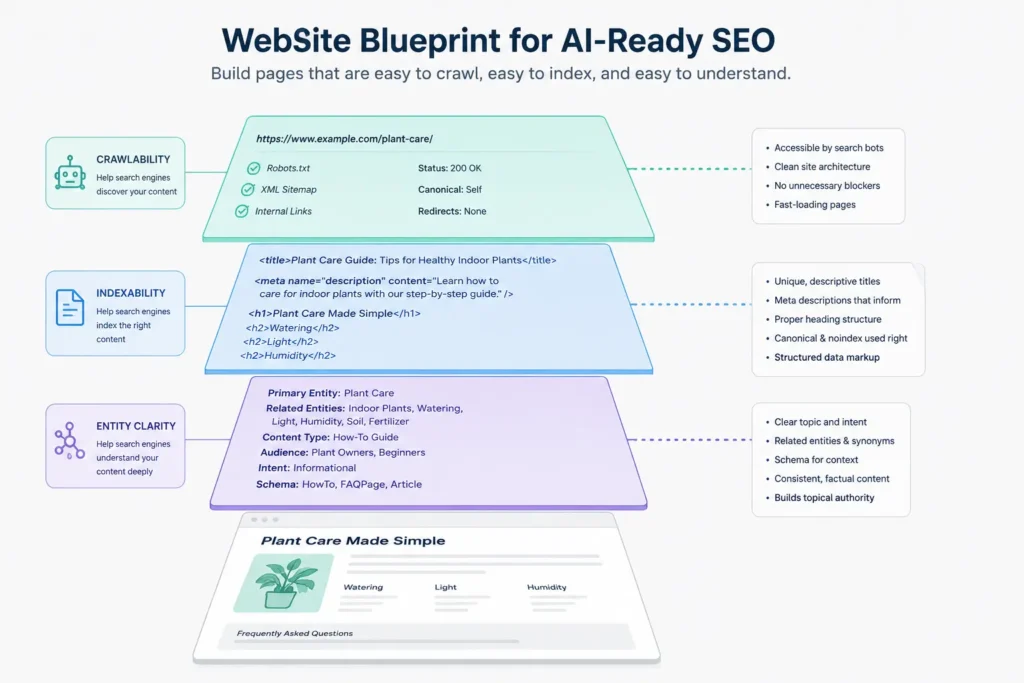
Crawlability means search and AI crawlers can actually reach your pages without getting stuck behind JavaScript walls or broken navigation. Indexability means Google has decided your page is worth storing and showing. Entity clarity is whether your brand, your service area, and your offer are unambiguous – not buried in vague taglines. None of this is new. AI search just raised the cost of getting it wrong.
In my audits, the sites that show up in AI answers are almost never the flashiest ones. They’re the ones with a clean content hierarchy – a clear H1, logical H2s, and answers that sit near the top of the page instead of three scrolls down past a hero slider. Google’s own guidance on how AI features interact with your website makes the same point in plainer terms: the same fundamentals that earn organic visibility are what earn AI visibility too. GEO isn’t a separate game running next to SEO. It’s SEO with a sharper grading rubric.
What Business Owners Usually Miss
This is the part nobody wants to hear, so I’ll say it plainly: most of the businesses asking me about AI search rankings aren’t ready for AI search rankings. Not because their product is bad. Because their website hasn’t done the groundwork yet.
- A lot of owners assume that if Google rankings are weak, AI rankings can somehow leapfrog them anyway. They can’t. AI engines lean heavily on the same crawled, indexed web that traditional search runs on.
- Some genuinely believe a tool – any tool – can force visibility into ChatGPT or AI Overviews on a fixed timeline. There’s no dashboard that injects your brand into a model’s answer. Influence is earned through citations, structure, and authority that accumulate over time.
- Page structure, schema, and technical quality get treated as “nice to have later.” In my experience, they’re the first thing that decides whether a crawler even understands what your page is about.
- A surprising number of teams think “AI-ready” is a label you slap on a homepage rather than an outcome of how the site is actually built.
And then there’s the “rank in 45 days” pitch. I’ve seen it land in inboxes of clients before they ever talked to me. It’s not just unrealistic – it skips the part where Google has spent years tightening what gets surfaced. Search behaviour and ranking criteria keep shifting with every core algorithm update, and no agency or AI tool sits outside that. Independent citation analysis has found that 90% of brands studied across healthcare, SaaS, and financial services had zero AI search mentions at all – which tells you visibility is earned by a minority, not handed out by a subscription.

What AI Engines Tend to Love
What business owners actually want to know is simpler than they make it sound: what does a page need so an AI engine picks it? From what I’ve seen across audits, a few patterns repeat constantly.
AI engines favor pages with answerability – content that states the answer plainly in the first few lines instead of building up to it. They favor trust signals: a real author, a real address, a real phone number, reviews that aren’t obviously fake. They favor internal linking that actually connects related pages instead of dumping every link in a footer nobody clicks. Fast-loading, mobile-friendly pages get the benefit of the doubt; slow ones get skipped, because the model has plenty of other candidates to pull from.
There’s also a structural layer that’s easy to overlook – building pages and content that an AI agent or crawler can parse cleanly, separate from making them appealing to a human reader. We cover that distinction in more detail in our piece on building AI-agent-friendly websites. Google’s own framing of optimizing for generative AI features lands on the same idea from the other direction: clarity and structure aren’t a workaround, they’re the requirement.
What AI engines don’t reward: keyword stuffing, recycled “ultimate guide” filler, or content written to please a checklist instead of a reader. Original expertise still wins. It just has to be packaged so a machine can find it.
Why Web Design Matters for GEO
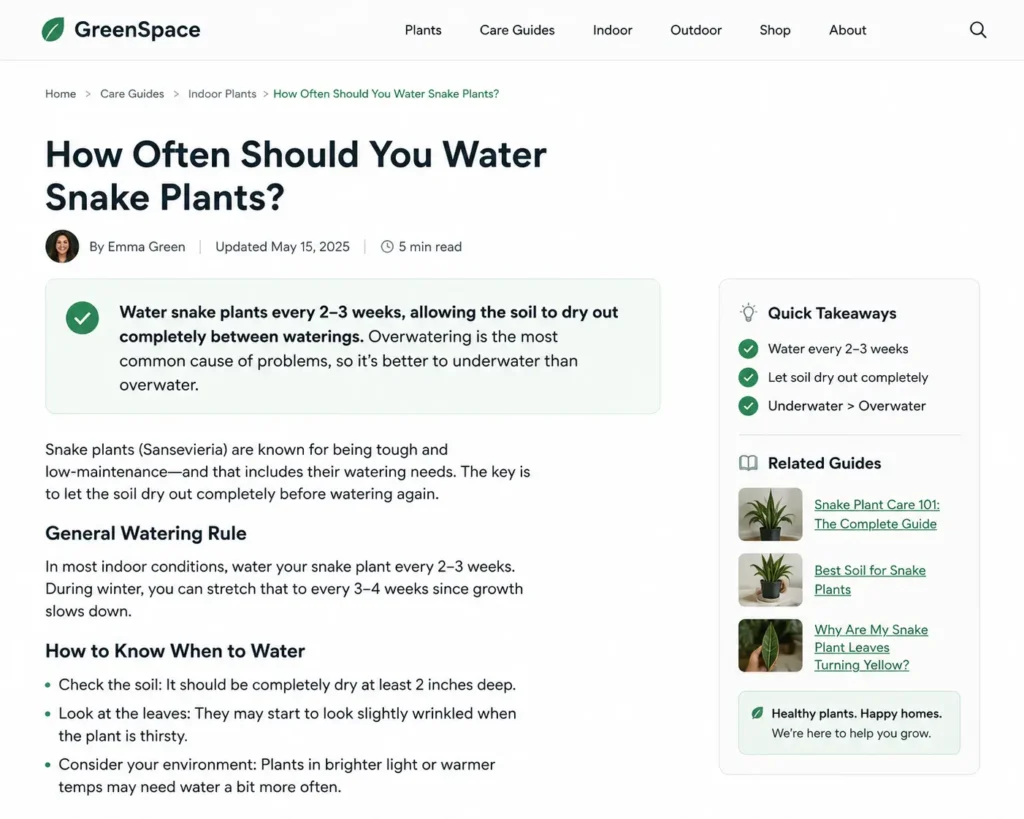
Design isn’t decoration here – it’s infrastructure. The way a page is laid out affects whether content can be extracted cleanly, whether headings actually map to the ideas they introduce, and whether a reader (human or AI) can tell what the page is for within the first few seconds.
Bad design creates friction even when the underlying content is genuinely good. A wall of text with no headings. A page that buries the answer under three carousels and an autoplay video. A mobile layout that breaks the heading order because someone designed desktop-first and never checked it. I’ve audited sites with smart, well-researched content that AI engines still skipped – because the structure never gave that content a fair shot at being understood.
When a site needs that kind of structural rebuild rather than a content patch, that’s a web design project, not an SEO tweak. The two have to work together; one without the other leaves real visibility on the table.
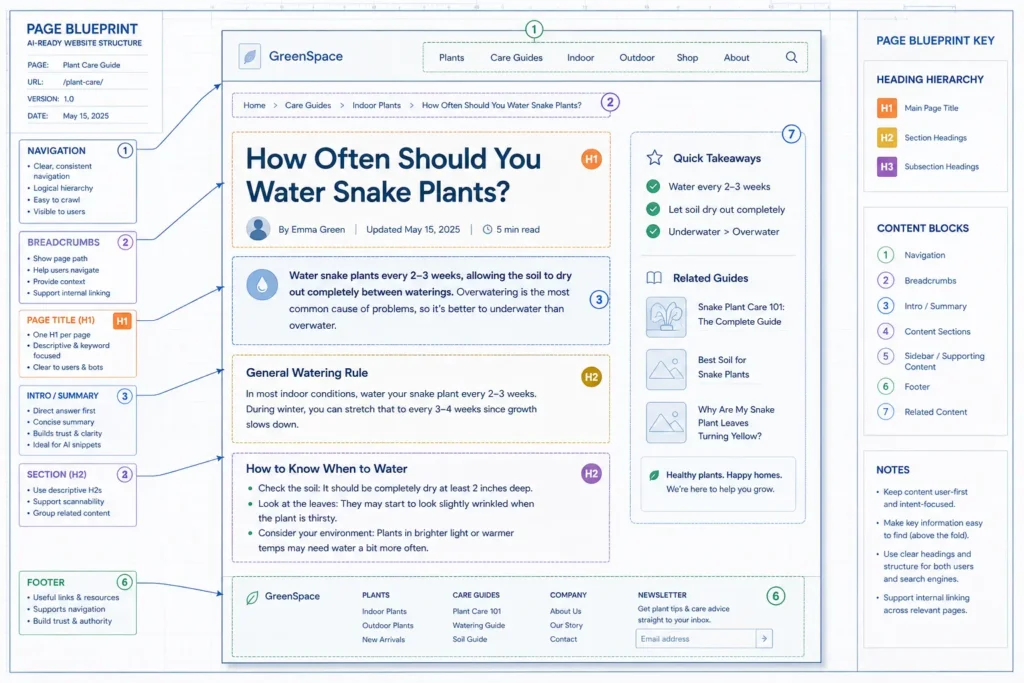
GEO-Ready Web Design Checklist
This is the practical version – the questions I actually run through during an audit, not a generic “best practices” list.
- Does every page have one clear intent, or is it trying to be a homepage, a landing page, and a blog post at the same time?
- Is the core answer visible without scrolling past hero banners and slider animations?
- Are headings structured logically – one H1, nested H2s and H3s – instead of styled to “look right” with no hierarchy behind them?
- Is there genuine topical authority here, or is this one thin page hoping to outrank a competitor’s twelve related ones?
- Do internal links connect to real, relevant pages on your own site, pulled from your actual sitemap – not invented URLs or vague “click here” links?
- Is schema markup present where it actually applies (Organization, Article, FAQ, Product), or is it missing entirely?
- Are images compressed, sized correctly, and saved in modern formats like WebP, instead of 4MB PNGs slowing the page down?
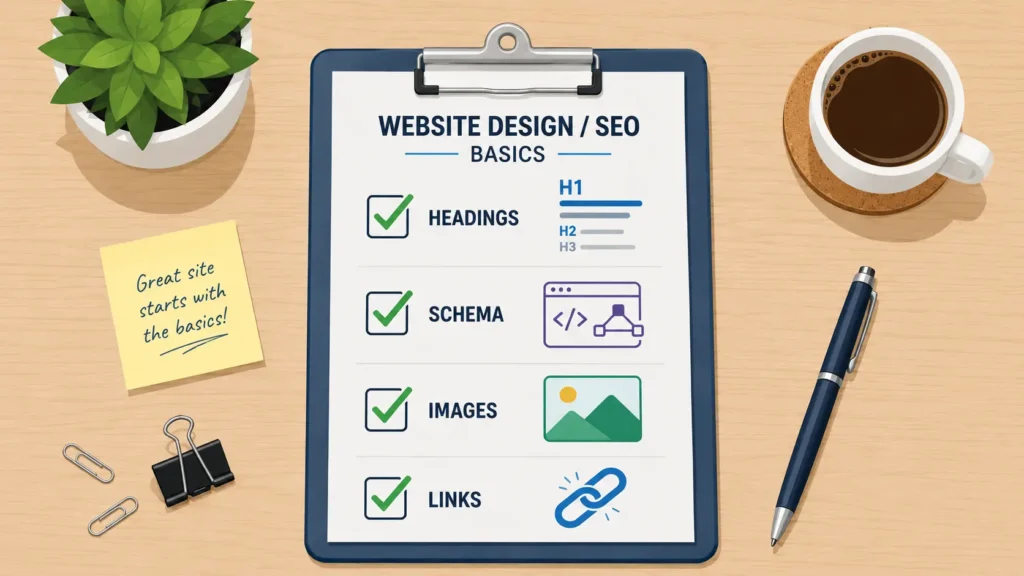
Technical Checklist
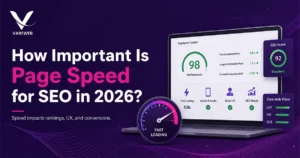
Speed, crawlability, and mobile usability decide whether AI systems and Google bots ever get a fair read of your content in the first place.
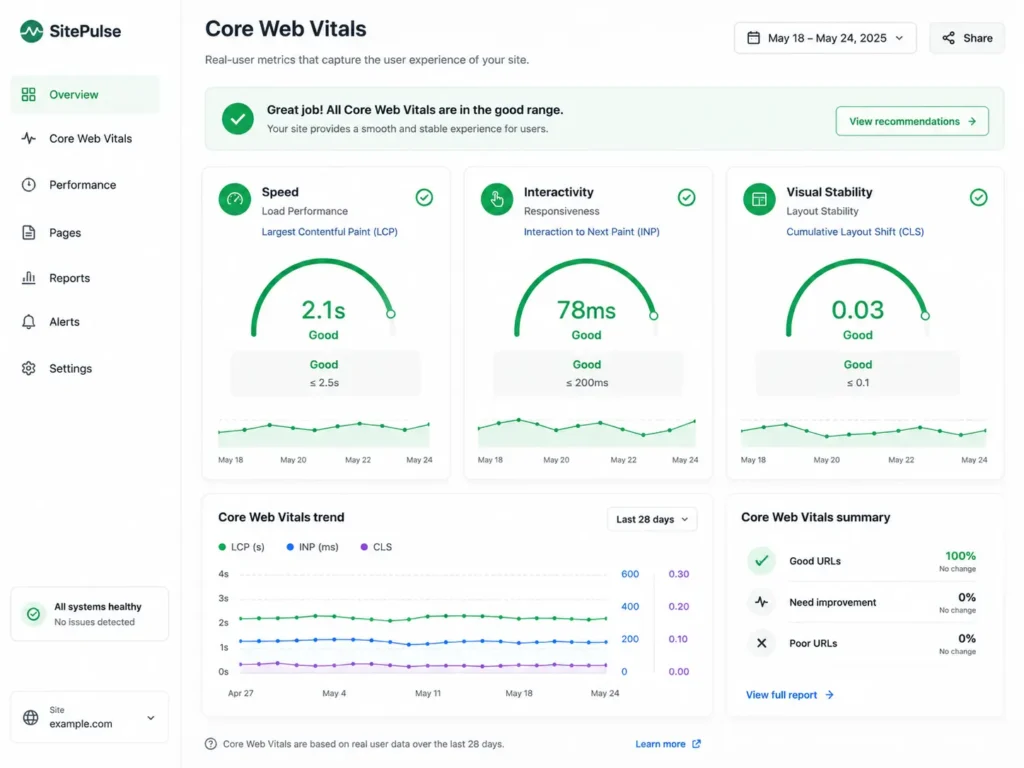
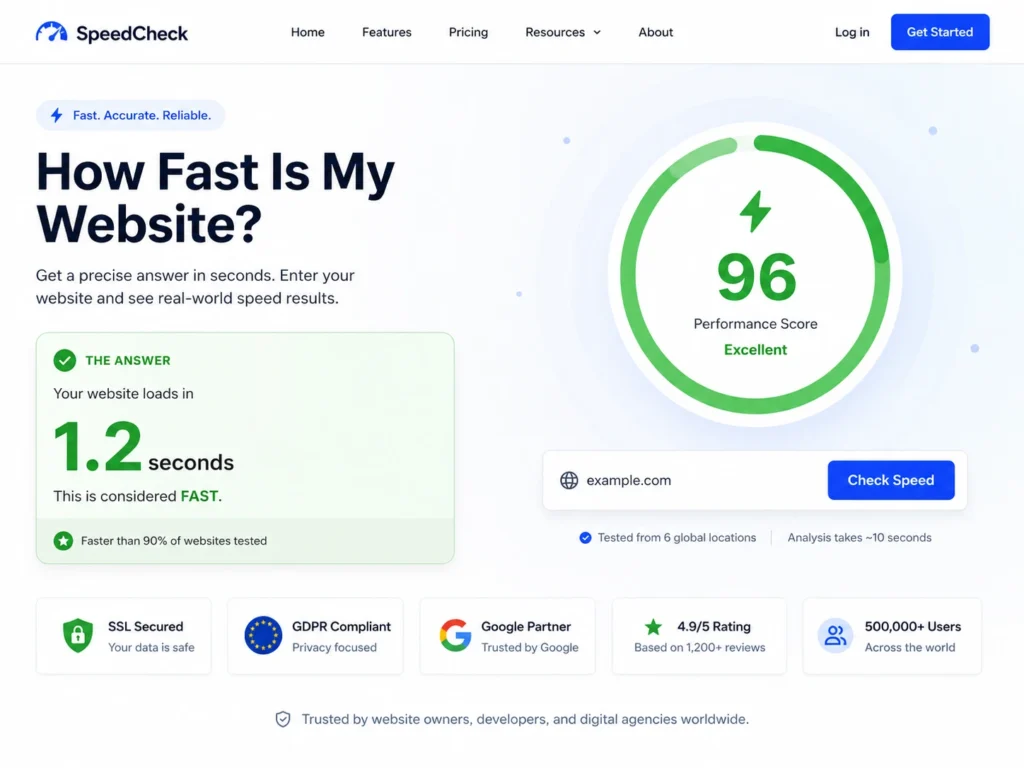
- Page speed: Slow pages get deprioritized before content quality is even evaluated. Google’s Core Web Vitals guidance is still the baseline most sites quietly fail.
- Mobile-first layout: Since most search and AI traffic now arrives on mobile, a desktop-first build with mobile as an afterthought is a structural risk, not a minor detail. Our breakdown on UI/UX habits that support strong Core Web Vitals goes deeper into this.
- Schema markup: Implemented correctly, it removes ambiguity about what a page is and who published it. We’ve written about how schema markup and web design work together in practice, not just in theory.
- Crawlability and indexability: Client-side-rendered pages with no server-side fallback are routinely missed by crawlers on lower-authority domains, even when the content itself is solid.
- Clean URL structure: Predictable, descriptive URLs help both crawlers and users understand what they’re about to read.
- No orphan pages: If a page has no internal links pointing to it, don’t be surprised when nothing – human or AI – finds it either.
Trust and Content Checklist
This is the part teams skip most often, and it’s usually the reason visibility stalls even after the technical boxes are checked.
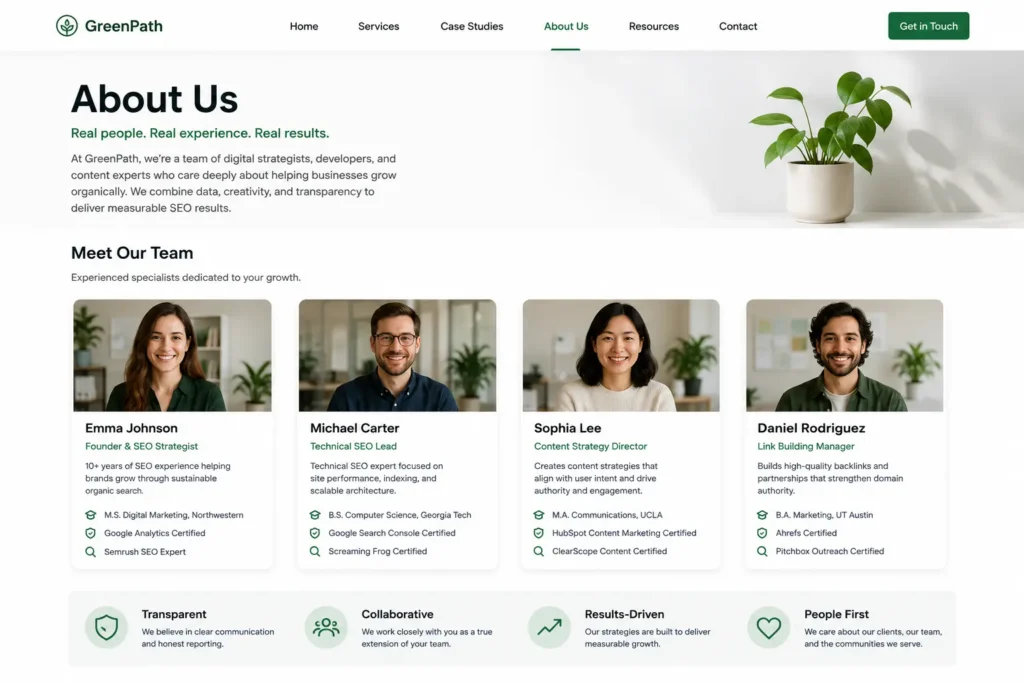
- Is there a real, specific About page – one that names actual people, actual experience, and actual credentials? We outline what that should include in our guide to writing an About Us page that builds trust.
- Is authorship attributed to a real person or team, instead of a generic “Admin” byline?
- Are claims and statistics backed by source links, rather than numbers floating with no attribution?
- Does the content read like it was written by someone who’s actually done the work, or does it sound like a template filled in with your brand name?
- Is there enough original insight here that a competitor couldn’t publish the same page with a find-and-replace?
- Does the page intent match the search intent – is a commercial page trying to do a blog post’s job, or vice versa?
Red Flags
These are the patterns that make AI visibility unlikely, almost regardless of how good the underlying offer is.
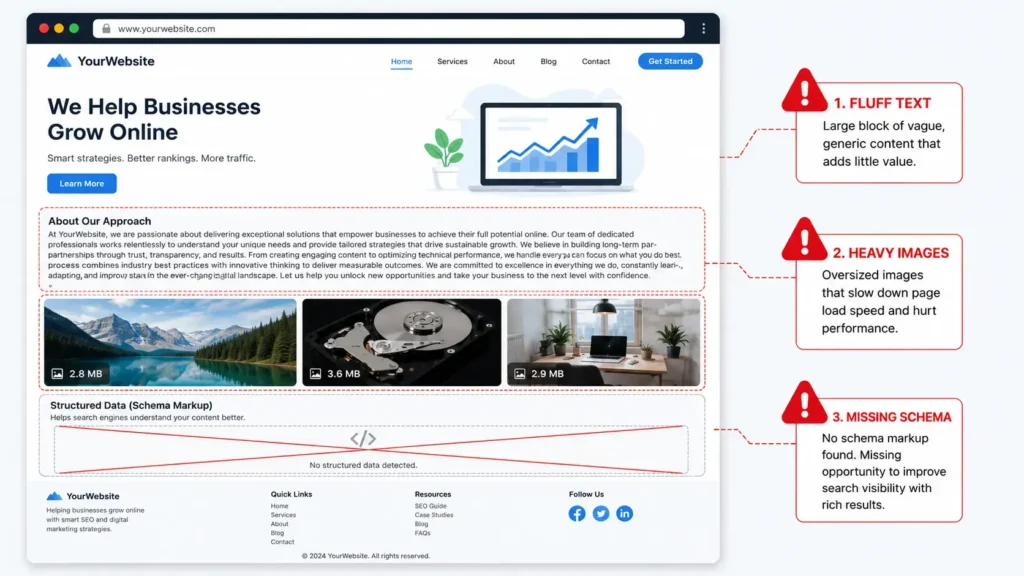
- Pages packed with fluff paragraphs that exist to hit a word count, not to answer anything.
- Heavy, uncompressed media that tanks load time on mobile.
- No schema markup anywhere on the site.
- Vague, generic “About Us” copy that could belong to any company in the industry.
- Zero internal links connecting related pages – every page an island.
- Duplicate or near-duplicate location and service pages that confuse rather than clarify intent.
- AI-generated copy published with no human edit, no fact-check, and no real point of view. We dug into exactly why this backfires in why AI-generated websites still convert poorly – the same shallowness that hurts conversions hurts AI citation odds too.
- Poor mobile UX that makes a page nearly unreadable below 768px.
- Slow load times that push past the threshold where impatient crawlers – and impatient humans – both give up.
What a GEO-Ready Site Looks Like
The green-flag version of all this isn’t complicated, even if it takes real work to get there.
Each page has one job and does it clearly. Answers are concise but complete – no padding, no missing steps. The site loads fast and reads cleanly on a phone screen, not just a 27-inch monitor in the office. Trust markers are visible without digging: real names, real reviews, real contact details. Internal structure actually guides a reader (or a crawler) from one relevant page to the next. Media is optimized instead of bloated. Schema is in place where it adds value. Heading hierarchy is logical from top to bottom. And the content itself is specific enough that an AI engine pulling an answer would actually have something worth quoting.
What to Fix First
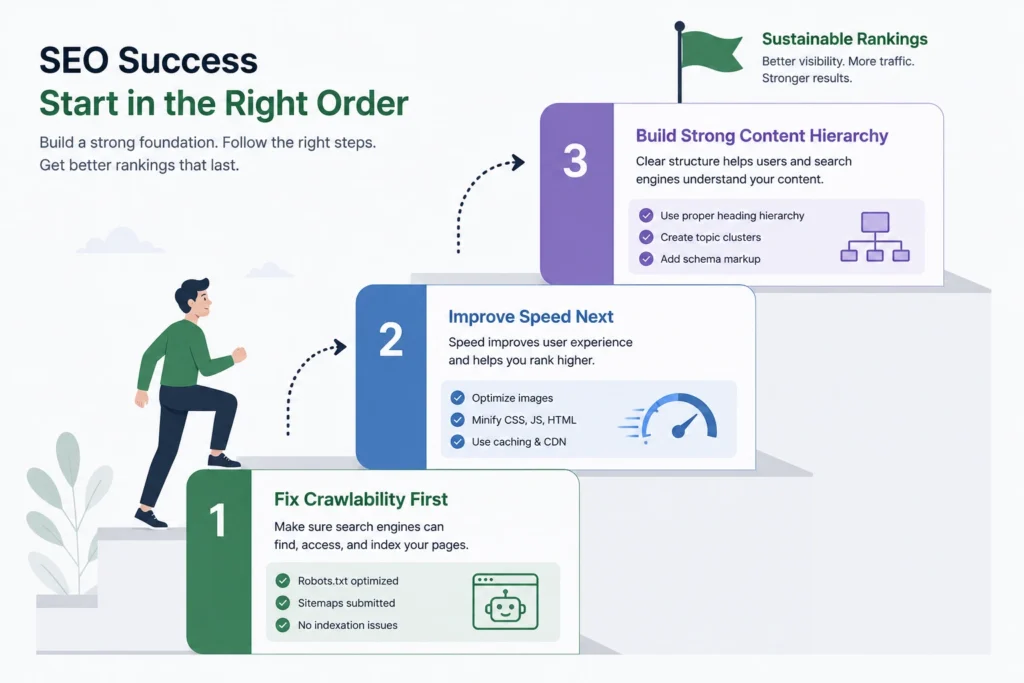
If your site isn’t there yet, here’s the order I’d actually work in, based on what tends to block everything else:
- Fix crawlability and indexability first. None of the rest matters if pages aren’t being read or stored properly.
- Then fix page speed and mobile usability. A fast, clean mobile experience is table stakes before anything else gets evaluated fairly.
- Rebuild content hierarchy and intent. Make sure each page answers one clear question, with the answer visible early.
- Add schema markup where it’s genuinely relevant. Don’t bolt it onto every page just to say you have it.
- Strengthen trust signals. About page, authorship, real contact information, source-linked stats.
- Clean up internal linking so related pages actually connect to each other.
- Only then think about scaling content and topical authority. Publishing more before the foundation is solid just multiplies weak pages.
Final Perspective
AI search readiness isn’t a switch you flip or a feature you buy. It’s the compounding result of a site that’s fast, structured, honest about who’s behind it, and genuinely useful to the person reading it. AI Overviews have moved from a limited rollout to a default search surface used by billions of monthly queries in under two years, and that pace isn’t slowing down – but the businesses earning a place inside those answers are the ones that did the unglamorous structural work months before anyone asked them about “AI rankings.” If your site isn’t built for that yet, the fix isn’t a faster tool. It’s starting at the foundation and working up.
FAQs
Can a bad website still rank in AI search?
Rarely, and not durably. A weak site might get a brief mention, but structural and trust problems catch up fast.
Does AI search care about page speed?
Yes. Slow pages get deprioritized before content quality is even assessed.
Is GEO different from SEO?
Not fundamentally. GEO sits on top of the same technical SEO and content quality foundations – it just adds a sharper layer of clarity and structure.
Can a tool make my site AI-ready?
A tool can audit or flag issues. No tool can build trust signals, fix content quality, or rebuild structure on its own.
Do I need schema for AI search?
Where it’s relevant, yes – it removes ambiguity. It’s not a universal requirement for every single page type.
What matters more: content or design?
Both, working together. Good content with poor structure often gets skipped; good design with thin content has nothing worth citing.
Can I rank in AI search without ranking on Google?
It’s very unlikely for most sites, since AI engines lean heavily on the same crawled, indexed web that traditional search uses.
How long does AI search readiness really take?
There’s no fixed number. It depends on how far the site is from the fundamentals – weeks for some, several months for others.